Quick Answer:
B2B SaaS marketing teams spend more time preparing reports than acting on them. Reporting delays decisions. In this article, AI-powered reporting refers to systems that automatically update, validate, and connect marketing information without manual dashboard maintenance. In practice, this includes automated data pipelines, cross-channel attribution logic, anomaly alerts, and query-based reporting. This breakdown covers how each approach works, where each breaks down, and which fits your team’s current stage.
TL;DR
● Manual dashboards: work for early-stage teams with limited channels and simple reporting needs.
● AI-powered reporting: for teams managing multi-channel campaigns where analyst time on prep exceeds time on analysis.
● Attribution accuracy: platform-level reporting conflicts between channels; cross-channel systems resolve it.
● Decision speed: manual reporting delays decisions by days; automated alerts surface issues in real time.
● Total cost: manual setups cost more in labor than software; the ratio shifts as team size grows.
Spending more time preparing reports than acting on them? Darwin builds the reporting infrastructure that fixes that.
How Manual Marketing Dashboards Work in B2B SaaS
Most B2B SaaS marketing teams follow the same reporting pattern. Information lives in multiple systems, reports are built manually, and each update requires pulling, cleaning, and reconciling records before anything can be reviewed. Spreadsheets come first, then a Business Intelligence (BI) tool, then months of pipeline maintenance that breaks on a schedule nobody planned for.
The Standard Dashboard Setup Process
Marketing dashboards begin with KPI alignment. Marketing and leadership agree on definitions for Customer Acquisition Cost (CAC), Return on Ad Spend (ROAS), and Lifetime Value (LTV) before any build starts. Without that agreement upfront, teams spend months debating funnel stages and metric ownership rather than reading reports.
Once KPIs are locked, teams map where the information lives. For B2B SaaS, this means web analytics, paid advertising accounts, Customer Relationship Management (CRM) systems, and email platforms. Platforms like Power BI, Tableau, or Looker connect to existing ecosystems without much friction. The specific tool matters less than how the reporting process is set up and maintained. The work starts after the connection is made.
Data Collection from Multiple Platforms
A standard B2B SaaS reporting stack pulls from Google Analytics 4, Google Ads, LinkedIn Ads, Salesforce or HubSpot, and email platforms. Each platform uses different naming conventions, date formats, and metric definitions. Matching these up manually becomes a recurring weekly task.
Most BI tools have connectors for dozens of services. Authenticating each one, navigating account hierarchies, selecting the right dimensions, and reconciling the output is what fills the hours.
Building Reports in BI Tools
Most teams open the query editor to transform raw pulls before loading. Renaming columns, merging datasets by date fields, creating calculated fields for conversion rates, and applying filters are standard steps. The output splits across three dashboard types: status dashboards for current funnel clogs, strategy dashboards for planning, and scrutiny dashboards for deep analysis.
Weekly Dashboard Reviews and Updates
Once built, dashboards require constant maintenance. Marketing teams spend 3-5 hours every Monday preparing weekly reviews. Manual pulls alone consume 10-15 hours per week. When teams leave those sessions without clear decisions, the meeting failed.
The Hidden Costs of Manual Dashboard Reporting
Manual dashboards look manageable until the actual time investment gets calculated.
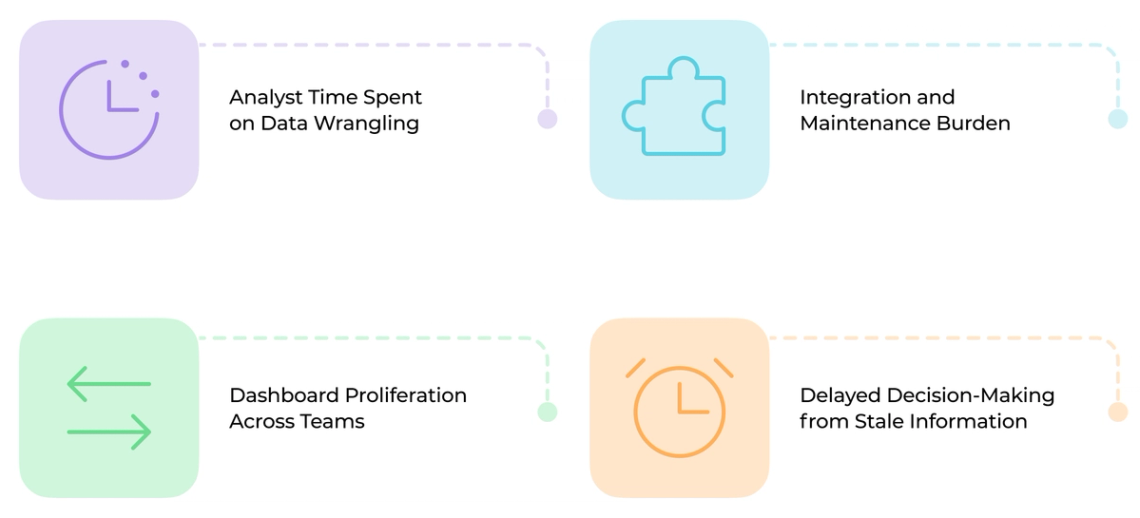
1. Analyst Time Spent on Data Wrangling
In manual reporting setups, analysts spend the majority of their time on data preparation, not analysis. Data preparation is the most time-consuming part of analytics work. Cleaning records, reconciling date formats, and fixing formulas take priority over finding insights. Manual tasks take three to five times longer than automated equivalents. The report gets built. The analysis waits.
“To get to AI-driven execution, you need a lot of foundational elements in place: clean data, integrated systems, clear governance policies, and organizational trust in AI decision-making.” – Jonathan Moran, Head of Marketing Technology Solutions, SAS
2. Integration and Maintenance Burden
Every dashboard added to a manual reporting setup creates ongoing maintenance work. Each one requires regular updates to stay accurate and relevant. As teams add sources and build more views, the load compounds. Skilled professionals end up in data entry roles. Department heads navigate through databases and spreadsheets to extract metrics, then transform raw figures into polished reports for executive review.
3. Dashboard Proliferation Across Teams
Different departments build their own views: sales needs acquisition costs, marketing wants traffic levels, finance needs revenue breakdowns. This duplication creates dashboards nobody actually uses. People underestimate how long finding specific information takes and overestimate how often they will need a given view. The result is more dashboards, more maintenance, and less clarity.
4. Delayed Decision-Making from Stale Information
By the time campaign figures get gathered, cleaned, and debated, the decision window often closes. Teams that rely on weekly manual pulls are working with information that reflects last week, not today.
If your analysts spend more time on preparation than on findings, Darwin can redesign the setup.
How AI-Powered Marketing Reporting Works
Automated reporting shifts analyst time from data preparation to data interpretation. AI handles the collection, cleaning, and formatting so that judgment gets applied to decisions rather than spreadsheets.
One constraint applies here: AI reporting works only when the underlying information is clean and the systems feeding it are connected. Automation applied to bad data surfaces the same bad numbers faster.
Automated Data Collection and Processing
AI-powered marketing reporting handles collection, validation, and formatting without manual input. Automated systems apply validation rules as records arrive. Inconsistencies get flagged without human review. What takes a full day to compile manually completes in minutes. Marketing teams report that automating routine tasks ranks as the top benefit, with 68% identifying this as the primary advantage.
AI-Generated Insights Without Manual Analysis
Teams ask questions in plain language and receive specific answers without opening a dashboard. AI surfaces correlations that manual review misses: conversion spikes tied to specific time windows, drop-off points in the trial-to-paid funnel, lead quality shifts by acquisition source. 62% of practitioners now use AI to synthesize and interpret reporting data.
“We’re seeing marketers upgrade from simple AI tools and use cases like chatbots and content generation to intelligent agents that help them expedite tasks and workflow automation.”
Kipp Bodnar, CMO, HubSpot
Real-Time Monitoring
AI-powered marketing reporting tools monitor campaign metrics continuously and alert teams when thresholds are crossed. Real-time analytics processes records as they arrive. Automated alerts notify teams when cost per conversion, conversion rate, or daily spend crosses preset thresholds. Notifications come via email, Slack, or SMS. Winning campaigns get caught while they scale. Losing ones stop before they drain the monthly budget.
Identity Resolution and Cross-Channel Attribution
Identity resolution connects records from multiple sources to individual users using deterministic and probabilistic matching. For B2B SaaS, this means a LinkedIn ad, a gated content download, a demo request, and a sales call can all trace back to the same contact. That complete view enables precise budget allocation without relying on platform-reported numbers that conflict by design.
When Manual Dashboards Still Make Sense for B2B SaaS
Manual setups work for teams running a limited number of channels with clear attribution. If a company runs primarily on organic content with one paid channel, building dashboards in existing tools keeps costs low. Small teams without dedicated analysts can manage weekly pulls and basic visualization without breaking their workflow.
Manual dashboards also hold up for executive reporting and board presentations, where a fixed set of metrics gets formatted the same way every quarter.
The point where manual reporting stops working is predictable: multi-channel campaigns, cross-platform attribution, and weekly stakeholder reporting from three or more sources. That is when the maintenance load outpaces the team.
Running more than two paid channels with no unified attribution view? Darwin builds the measurement layer.
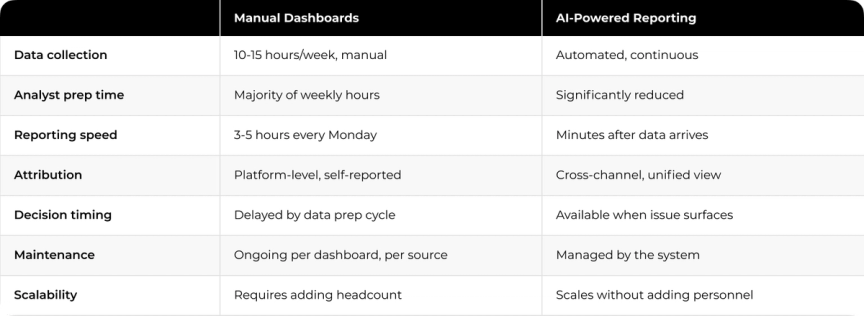
Side-by-Side Breakdown: AI-Powered vs Manual Dashboards
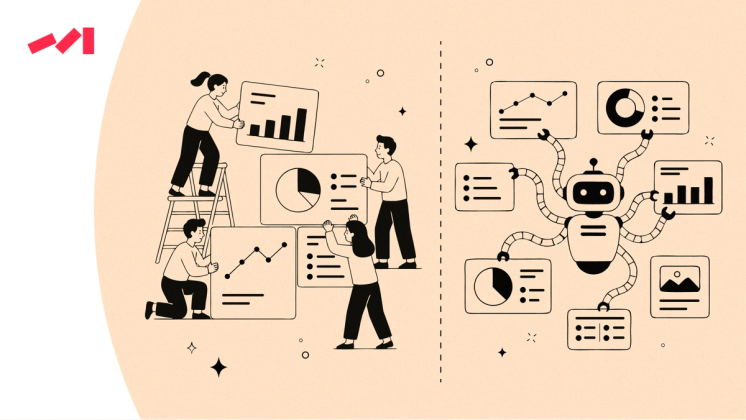
The operational differences between manual and automated reporting show up in specific, measurable ways.
Choosing the Right Approach for Your B2B SaaS Team
Choosing between manual dashboards and AI-powered reporting depends on channel count, attribution requirements, and how much analyst time goes to preparation.
When to Start with Manual Dashboards
Manual setups make sense at early stage: limited channels, no dedicated analytics function, simple reporting cadence. If the team can maintain dashboards weekly and the attribution need is clear, the tooling cost stays low and the setup stays under control.
When AI-Powered Reporting Makes Sense
As marketing organizations scale, the volume of campaigns outpaces what manual workflows support. When multi-channel campaigns run across paid search, social, display, and account-based plays at the same time, the reporting gap becomes a real operational problem. Teams that move to automated reporting consistently spend fewer hours on preparation and more on decisions.
Hybrid Approach: Using Both Together
The most effective setup combines automated processing with human review. AI drafts the reports. The team reviews summaries, adds interpretation, and makes the calls. Speed increases without losing the judgment that separates sound marketing decisions from algorithmic outputs.
How Darwin Can Help
Measurement fails when tracking, attribution, and KPI logic drift apart. Darwin realigns the system before optimization begins.
We work with B2B SaaS marketing teams on the full reporting setup: reviewing tracking architecture, resolving attribution conflicts, and connecting channels into a single source of truth. The process starts before any advanced modeling is introduced, so the foundation supports the analysis.
Wizehire, an HR tech SaaS, came to Darwin with a familiar problem: paid campaigns running across multiple channels, but no reliable way to see which ones were actually working. After cleaning the tracking layer and expanding tracked conversion events from four to nine, the team finally had reporting they could act on. Cost per lead dropped 26% and funnel volume grew 60% within four months.
If your team is spending more time preparing reports than acting on them, that is the gap worth closing first.
If your team is still relying on manual reporting, Darwin can help you build a setup that scales more cleanly.
FAQs
Q1. What does AI-powered marketing reporting actually include?
In practice, AI-powered reporting covers automated data pipelines, cross-channel attribution logic, anomaly detection alerts, and query-based reporting. It handles the collection and formatting layer so that analyst time goes toward interpretation rather than preparation.
Q2. How much faster is automated data processing compared to manual methods?
Manual data capture takes 5-15 minutes per record. Automated systems complete the same task in 15-60 seconds. That speed difference compounds across hundreds of data points weekly. The bigger impact is not processing speed but the hours recovered from weekly report preparation.
Q3. What is the main problem with platform-level attribution?
Each platform claims full credit for the same conversion. When a prospect sees a LinkedIn ad, downloads a guide, requests a demo, and closes three weeks later, every platform in that chain reports the full outcome. Cross-channel attribution eliminates this conflict by operating outside individual platforms.
Q4. When does it make sense to stay with manual dashboards?
Manual dashboards work for teams with limited marketing channels and clear attribution needs. Companies running primarily organic content with one paid channel can manage weekly pulls without a dedicated analytics function.
Q5. What is the first step toward fixing a broken reporting setup?
Start with the tracking layer. Inconsistent event naming, misaligned KPI definitions, and disconnected platforms are the most common causes of unreliable reporting. Fixing those before adding automation or AI tooling prevents the same problems from reappearing at higher speed.
Q6. What is the difference between AI-powered marketing reporting and a standard BI dashboard?
A BI dashboard displays information that was manually pulled, cleaned, and loaded. AI-powered marketing reporting automates those steps: data pipelines update on a schedule, validation rules apply automatically, and anomalies surface without anyone checking. The dashboard becomes an output of the system, not the system itself.
 Sergey Kisly