Quick Answer:
The best marketing automation tools for mid-market SaaS connect directly to CRM and pipeline data, not just email. The right choice depends on your go-to-market motion: product-led, sales-assisted, or outbound. This guide compares seven platforms by what actually moves leads through the funnel, not feature count.
TL;DR
- This guide is for mid-market B2B SaaS marketing and ops teams evaluating automation platforms in 2026.
- The deciding factor: CRM and pipeline connection. Tools that don't sync to your CRM create attribution gaps.
- ActiveCampaign. Strong AI-driven nurturing at the best price-to-feature ratio for teams under 10,000 contacts.
- HubSpot. Best when marketing, sales, and CRM need to run in one place. High onboarding cost.
- Customer.io. Best for product-led teams sending event-triggered messages with high technical control.
- n8n. Workflow automation for ops teams connecting tools without native integrations.
- Clay. Outbound enrichment and prospecting. Not a full marketing automation platform on its own.
- Salesforce Marketing Cloud / Pardot. Built for teams already running Salesforce. High implementation cost.
- Marketo Engage. Enterprise-grade for complex B2B pipelines. Requires a dedicated MOps team.
The right marketing automation tools get complicated to find when you're a mid-market SaaS company. Too simple and you outgrow them in six months. Too enterprise and you're paying for features you'll never touch.
The harder problem is not picking a tool. It's what happens after. Marketing runs automation, sales works in Salesforce, and the numbers never fully agree. Leads fall through gaps between systems. Attribution breaks at the handoff point.
This guide covers seven platforms built for mid-market B2B SaaS teams. The focus is on what connects to CRM and pipeline data, not just what sends emails.
1. ActiveCampaign

ActiveCampaign is a marketing automation platform for mid-market B2B SaaS teams that need AI-driven email, behavioral lead scoring, and CRM sync without enterprise pricing.
Best for: Mid-market B2B SaaS with complex email and CRM workflows.
When to choose: You need AI-driven nurturing connected to pipeline, and enterprise pricing is not on the table.
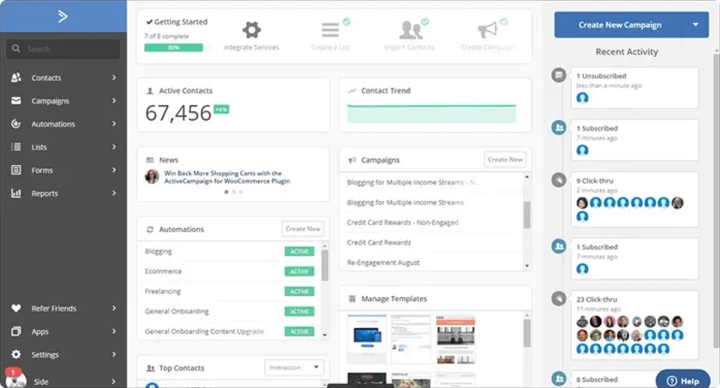
What Does ActiveCampaign Do for Mid-Market SaaS?
ActiveCampaign's AI engine analyzes your contact database and surfaces audience segments based on behavioral patterns that predict conversion. Behavioral lead scoring updates in real time as contacts engage. The platform includes 900+ automation templates covering the most common SaaS workflows.
Predictive Sending analyzes each contact's historical open patterns and delivers emails during their most likely engagement window. The visual automation builder accepts plain-language prompts, type 'Send 3 emails with a 2-day wait' and the system builds it.
Motrain, an education gamification platform, now converts trials at over 20%, up from under 10% before ActiveCampaign, saving 15 hours per week.
"Autonomous marketing delivers results from day one. Whether it's creating and sending campaigns in minutes or getting personalized recommendations without prompting, businesses will experience improved marketing performance right away." Jason VandeBoom, Founder and CEO, ActiveCampaign
ActiveCampaign Pricing and Plans
- Starter: $19/month, 1,000 contacts, 1 user
- Plus: $59/month, 1,000 contacts
- Professional: $99/month, 1,000 contacts, 3 users
- Enterprise: $179/month, 1,000 contacts, 5 users
Prices scale with contact count. 14-day free trial available. CRM add-on starts at $68/month.
ActiveCampaign Integration Ecosystem
ActiveCampaign connects with over 1,000 apps, including deep integrations with Salesforce, HubSpot, Pipedrive, and Microsoft Dynamics. Third-party triggers start automations when events occur in connected apps, closing attribution gaps between ad spend and closed-won revenue.
2. HubSpot Marketing Hub
HubSpot Marketing Hub connects marketing automation, CRM, and sales data in one platform, built for mid-market SaaS teams that need unified attribution across the full customer lifecycle.
Best for: Teams that want marketing, CRM, and sales running in one place.
When to choose: You are scaling past basic email and need attribution across the full pipeline, not just top-of-funnel.
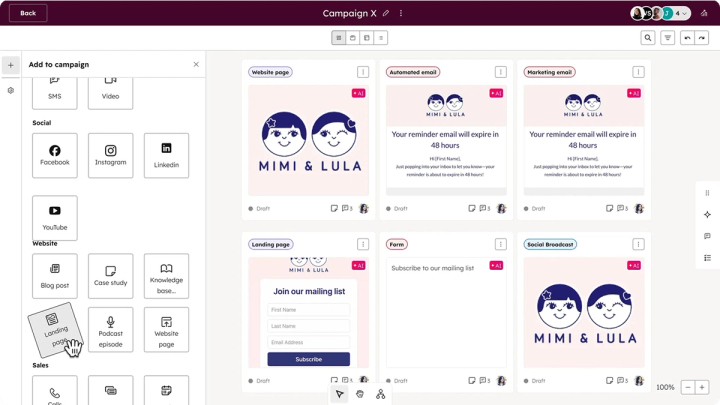
What Does HubSpot Marketing Hub Do for Mid-Market SaaS?
Workflows trigger on deal stage changes, lead scores, and custom behavioral events. Multi-touch revenue attribution, customer journey mapping, and custom reporting that handles large query volumes on Enterprise plans.
The Prospecting Agent researches contacts using 12 months of engagement history. The AI Email Writer uses CRM context rather than generic templates. Predictive lead scoring (Enterprise only) calculates likelihood-to-close.
Technology companies using HubSpot see 115% more inbound leads within 12 months.
"Marketers tell us that they are still struggling with integration between their marketing automation platforms and other software they use to run the business. That's why partnerships that bring information onto the contact record, timeline and CRM are important." Kipp Bodnar, CMO, HubSpot
HubSpot Pricing and Plans
- Starter: $20/month, 1 seat, 1,000 contacts
- Professional: $800/month, 3 seats, 2,000 contacts, $3,000 onboarding fee
- Enterprise: $3,600/month, 5 seats, 10,000 contacts, $7,000 onboarding fee
HubSpot Credits, introduced in late 2025, add consumption-based costs for Breeze AI features. Heavy use creates unpredictable bills when monthly allocations run out.
HubSpot Integration Ecosystem
HubSpot integrates with over 1,000 third-party tools. The average customer has over 9 apps installed; 92% use at least one marketplace app.
3. Customer.io

Customer.io is a behavioral messaging platform for product-led SaaS teams that need event-triggered, personalized messages based on in-app user actions.
Best for: Product-led SaaS teams sending behavioral, event-triggered messages.
When to choose: You have product event data and need fine-grained control over messaging logic that most email tools can't support.
What Does Customer.io Do for Product-Led SaaS?
Customer.io ingests events directly from your product: feature activations, trial starts, subscription changes, and uses those as triggers for automated messages. The visual workflow builder handles branching logic and conditional paths without requiring code.
The platform supports email, SMS, push notifications, in-app messages, and Slack. Liquid templating allows deep personalization using any attribute or event property in your data.
Product-led teams use Customer.io to trigger onboarding sequences when users complete specific setup steps, send upgrade prompts based on usage thresholds, and re-engage users who go inactive after a trial.
Customer.io Pricing and Plans
- Essentials: $100/month for up to 5,000 profiles, email and SMS included
- Premium: custom pricing, adds Data Pipelines, higher volume, priority support
- Enterprise: custom pricing, dedicated infrastructure, SSO, SLA
Customer.io Integration Ecosystem
Customer.io connects with Segment, Twilio, Stripe, Salesforce, and most major data tools via API or native integrations.
4. n8n

n8n is a workflow automation tool for marketing ops and RevOps teams that need to build custom automation between tools without native integrations.
Best for: Marketing ops teams building custom automation between tools.
When to choose: You need to automate data flows or lead routing between systems that don't connect natively, without waiting on engineering.
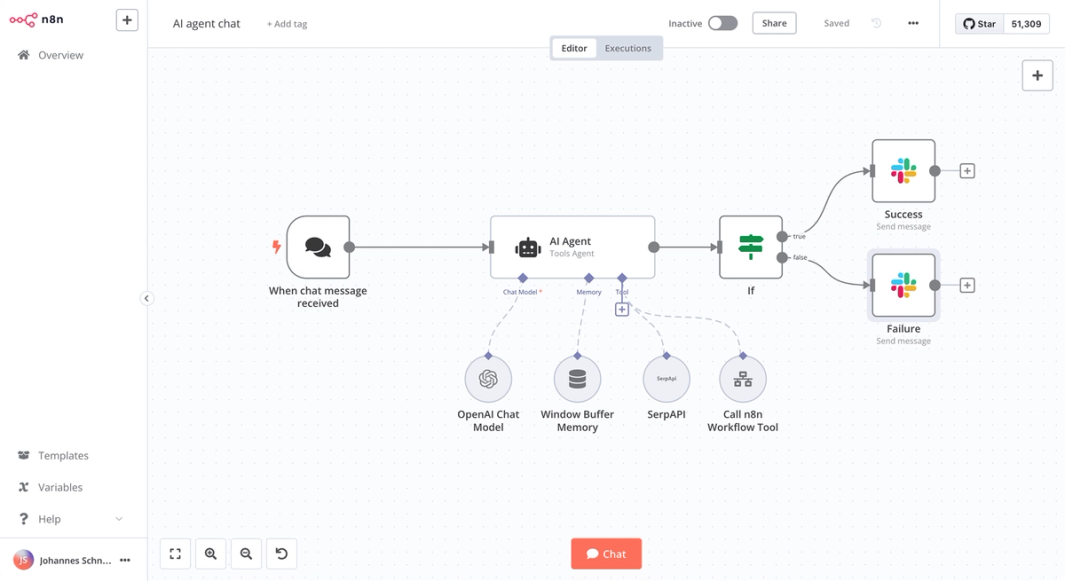
What Does n8n Do for Marketing Operations?
n8n uses a node-based visual builder where each step is a discrete action: pull data from one system, transform it, push it to another. Over 400 native integrations cover CRMs, databases, and communication tools. The self-hosted version is free; cloud starts at $24/month.
Common use cases: routing inbound leads from form tools to CRM based on scoring logic, syncing product event data to email platforms, and automating Slack alerts when key pipeline events occur.
n8n is not a replacement for HubSpot or ActiveCampaign. It is the connective layer that makes those tools work together. SaaS ops teams use n8n to pull enriched data from Clay, push it to Salesforce, and trigger sequences in ActiveCampaign, without custom engineering.
n8n Pricing and Plans
- Community (self-hosted): free, unlimited workflows
- Starter: $24/month cloud, 5 active workflows
- Pro: $60/month, 15 active workflows
- Enterprise: custom pricing, unlimited workflows, SSO
n8n Integration Ecosystem
n8n connects with 400+ apps natively including Salesforce, HubSpot, Slack, Google Sheets, Airtable, and Stripe. Custom HTTP nodes cover integrations not in the native library.
5. Clay
Clay is a data enrichment and prospecting tool for revenue and growth teams that need to build data-enriched outbound sequences connected to CRM.
Best for: Revenue teams doing outbound enrichment and prospecting.
When to choose: You are running outbound and need to enrich leads with signal data before routing them into sequences.
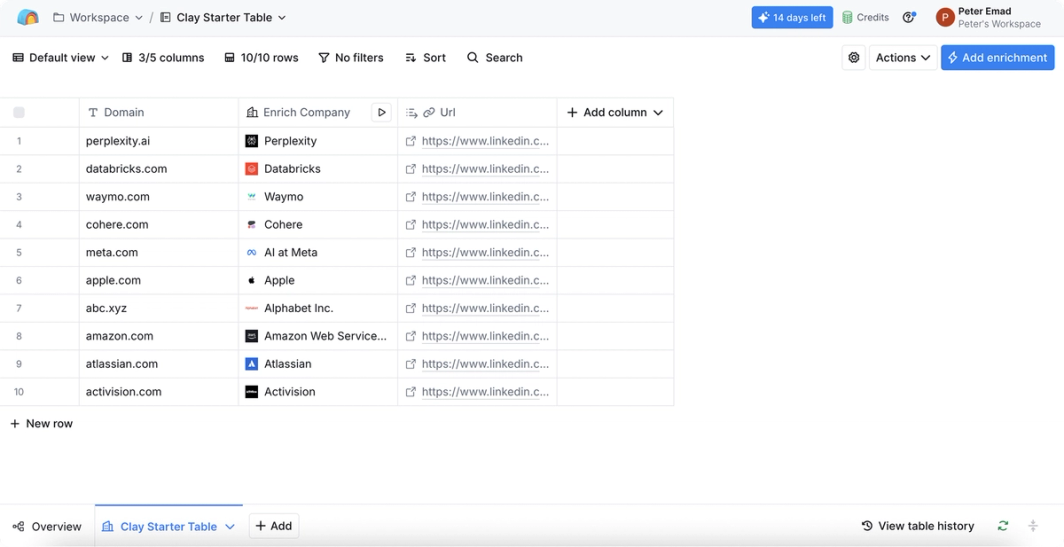
What Does Clay Do for Outbound and Prospecting?
Clay's waterfall enrichment model runs multiple data providers in sequence until it finds a match: email, phone, job title, LinkedIn activity, funding data. Claygent, their AI agent, researches companies and fills custom fields automatically.
The platform connects to CRM systems to push enriched data directly into Salesforce or HubSpot records, then triggers outbound campaigns when a lead meets enrichment criteria.
Growth teams use Clay to build outbound lists based on job change signals, enrich inbound leads before they reach sales, and automate the research step that previously took SDRs hours per day.
Clay Pricing and Plans
- Starter: $149/month, 2,000 credits/month
- Explorer: $349/month, 10,000 credits/month
- Pro: $800/month, 25,000 credits/month
- Enterprise: custom pricing
Clay Integration Ecosystem
Clay connects with Salesforce, HubSpot, Outreach, Salesloft, and Apollo. The 75+ data providers include LinkedIn, Clearbit, ZoomInfo, and Hunter.
6. Salesforce Marketing Cloud / Pardot
Salesforce Marketing Cloud Account Engagement (formerly Pardot) is enterprise B2B marketing automation for teams already running Salesforce CRM, with deep bidirectional sync and native pipeline visibility.
Best for: Enterprise B2B teams already running Salesforce CRM.
When to choose: Your sales team lives in Salesforce and you need marketing data surfaced directly inside CRM records.
What Does Salesforce Pardot Do for B2B Marketing?
Pardot's dual qualification model combines lead scoring (engagement-based) with lead grading (fit-based). A highly active but poorly matched lead doesn't get prioritized over a quieter but better-fit account. Both metrics surface inside Salesforce. Organizations using marketing automation report conversion rates increasing by up to 53%.
Sales reps access complete engagement histories: which emails prospects opened, what content they consumed. Automated lead assignment triggers within Salesforce when prospects hit MQL scores, eliminating manual handoff delays.
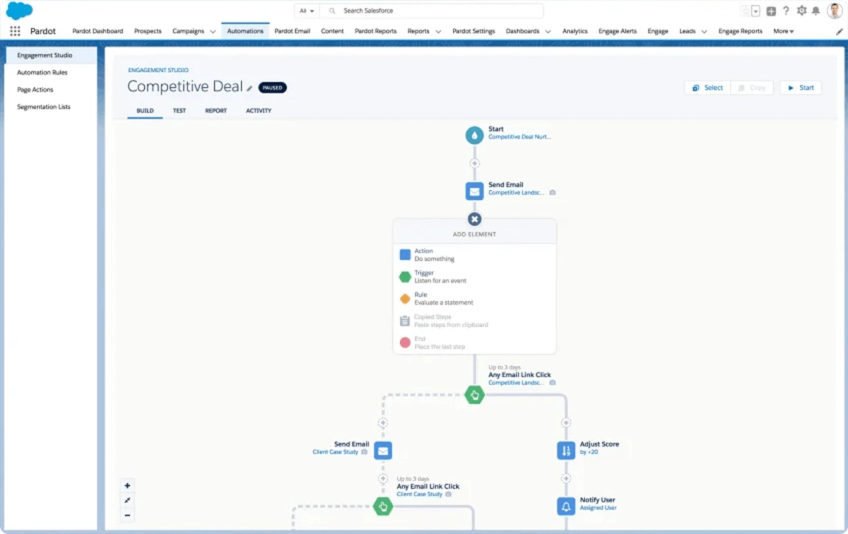
Engagement Studio visualizes multi-step campaigns with conditional logic. Progressive profiling gathers additional data over time without lengthy forms.
Salesforce Pardot Pricing and Plans
All tiers billed annually. A Salesforce CRM license is required separately.
- Growth+: $1,250/month, 10,000 contacts, 50 automation rules
- Plus+: $2,750/month, 100 rules, unlimited forms/landing pages
- Advanced+: $4,400/month, 150 automation rules
- Premium+: $15,000/month, 75,000 contacts
Implementation runs $5,000–$25,000 depending on complexity.
Salesforce Pardot Integration Ecosystem
The Salesforce connector syncs data bidirectionally approximately every 2 minutes. Additional integrations cover Google Analytics, Facebook, Zapier, and Eventbrite.
7. Marketo Engage
Marketo Engage is enterprise-grade B2B marketing automation for organizations with complex pipelines, long sales cycles, and dedicated marketing operations teams.
Best for: Complex B2B pipelines with multi-touch attribution requirements.
When to choose: You have a dedicated MOps team, multi-stakeholder buying processes, and need account-based features with granular attribution.
What Does Marketo Engage Do for Complex B2B Pipelines?
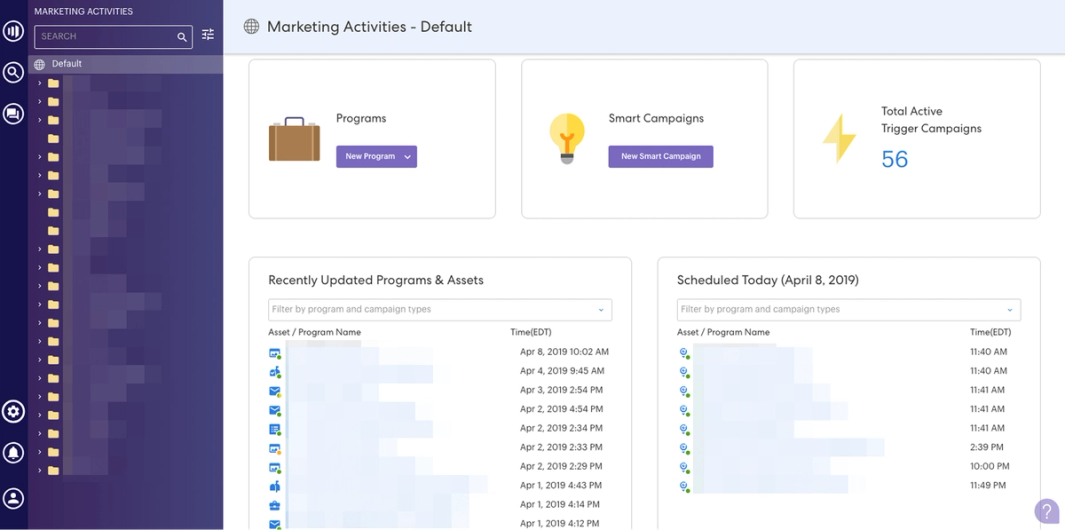
Marketo's Smart Campaign engine handles complex lead lifecycle programs with trigger-based and batch logic. Smart Lists allow segmentation across hundreds of attributes.
Revenue Cycle Analytics maps the full funnel from first touch to closed-won, with stage-by-stage conversion rates. Marketo Sales Insight surfaces marketing engagement directly inside Salesforce and Microsoft Dynamics for sales reps.
Mid-market SaaS teams with complex enterprise sales cycles use Marketo to run multi-touch nurturing programs and show MOps leadership which programs contributed to pipeline, not just which generated leads.
Marketo Engage Pricing and Plans
Marketo pricing is not published. Estimates from market research:
- Growth: from approximately $1,000/month
- Select: from approximately $1,750/month
- Prime: from approximately $3,175/month
- Ultimate: custom pricing
Implementation typically runs $10,000–$50,000. A dedicated MOps resource is required for long-term management.
Marketo Engage Integration Ecosystem
Marketo integrates natively with Salesforce and Microsoft Dynamics. Key integrations cover Zoom, ON24, LinkedIn, Google Ads, and major data enrichment tools.
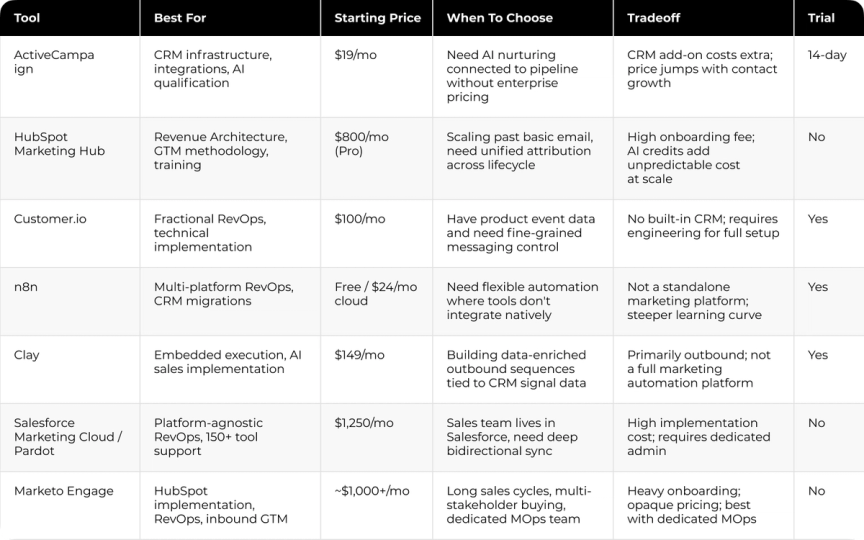
Comparison Table
How Darwin Helps Teams Connect Marketing Automation to Pipeline
Getting the right tool live is only part of the work. The real challenge is connecting it to CRM, attribution systems, and existing reporting so leads, pipeline stages, and campaign results stay consistent across systems. Most mid-market SaaS teams find out this is harder than expected six months after launch.
Darwin works at the infrastructure layer of marketing ops. The work is connecting automation tools to the systems that already exist: CRM sync, event tracking setup, lead routing logic, and attribution that holds when a deal closes.
This typically includes:
- Integrations and Automations: connecting marketing automation to CRM, attribution tools, and internal systems so leads flow without manual routing or data loss
- Data and Analytics: building the reporting layer that connects campaign activity to closed revenue, so the numbers agree across marketing and sales
With the right setup, automation connects to pipeline. Teams can add channels, swap tools, and adjust targeting without rebuilding attribution from scratch each time.
FAQs
Q1. What makes marketing automation tools essential for mid-market SaaS companies in 2026?
Mid-market SaaS teams have outgrown basic email tools but can't justify enterprise pricing or implementation timelines. Marketing automation at this tier handles lead scoring, behavioral triggering, and CRM sync. These three capabilities determine whether marketing spend shows up in pipeline or stays invisible in a separate system.
Q2. How does AI-powered marketing automation differ from traditional platforms?
Traditional automation runs on rules you define. AI-powered platforms analyze behavioral patterns across your database and surface segments, send times, and optimizations automatically. The practical difference is speed: the system identifies what's working without requiring manual analysis. But without consistent CRM data feeding into the platform, those improvements rarely translate into pipeline. AI surfaces better signals; it does not fix broken data flows.
Q3. How much do marketing automation tools cost for mid-market SaaS in 2026?Marketing automation pricing for mid-market SaaS ranges from $19–$100/month for entry-level tools to $800–$2,800/month for professional tiers with CRM and attribution features. Enterprise platforms like Pardot and Marketo typically start at $1,250/month and require separate CRM licenses and implementation budgets of $5,000–$25,000. The total cost depends less on the tool itself and more on CRM integration, data volume, and implementation complexity.
Q4. Which platform works best for product-led SaaS?
Customer.io is built for event-triggered messaging based on in-app behavior. It handles product-led use cases better than most marketing automation platforms. Requires more technical setup than HubSpot or ActiveCampaign.
Q5. How important are integrations when selecting a tool?
Integration depth matters more than integration count. Real-time bidirectional CRM sync determines whether attribution holds. Evaluate CRM sync quality, product analytics connections, and payment tool integrations before counting the total list.
Q6. Can n8n replace a dedicated marketing automation platform?
No. n8n handles workflow and data routing between tools. It does not replace campaign management, email sending, or behavioral tracking. The two work best together: n8n as infrastructure, a dedicated platform as the campaign execution layer.
Q7. Why do marketing automation tools fail after implementation?
Because setup is treated as a one-time task. In reality, workflows break as soon as lifecycle stages, lead routing rules, or data models change. A tool configured for one ICP or funnel structure does not automatically adjust when the business changes. Most mid-market SaaS teams hit this 9 to 12 months in, when the initial setup no longer reflects how the team actually sells.