
Quick Answer
Google Analytics 4 (GA4) compliance cost for B2B SaaS ranges from €5,000 for small organizations to over €3 million for enterprises operating across multiple jurisdictions. The expenses include consent management platforms, legal documentation, engineering time, and ongoing General Data Protection Regulation (GDPR) audits, none of which appear in Google’s pricing.
TL;DR
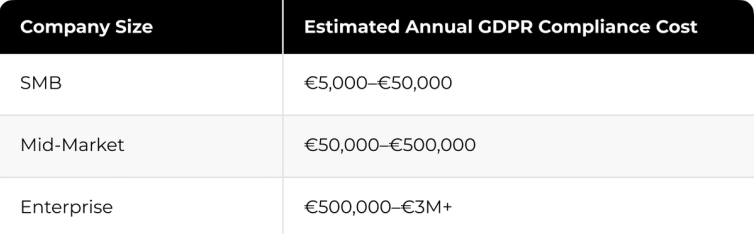
• GA4 GDPR compliance costs range from €5,000 to €3M+ depending on company size and jurisdictions served.
• Cookie opt-outs create 30-40% attribution gaps in B2B sales funnels, reaching 50-60% in EU markets with compliant banners.
• GDPR fines totaled €1.2 billion in 2025 alone; the cumulative total since 2018 now exceeds €7.1 billion.
• Enterprise sales cycles extend four to 12 weeks due to DPA negotiations triggered by GA4 usage.
• Privacy-first tools like Plausible ($9/month) and self-hosted Matomo eliminate consent requirements and capture 100% of traffic.
Not sure what your GA4 setup actually costs in compliance overhead? Darwin can map it.
GA4 is listed as free. Compliance costs appear during implementation and continue to grow over time.
European data protection authorities issued €1.2 billion in GDPR fines in 2025, bringing the cumulative total to over €7.1 billion since May 2018. Average US breach costs reached a record $10.22 million in 2025, according to IBM. For B2B SaaS companies using GA4, the compliance overhead goes well beyond legal exposure.
This article explains what GA4 compliance costs in practice: setup expenses, engineering time, risk exposure, and the accuracy problems that follow. You will learn what GA4 GDPR compliance actually demands, why compliance failures hit B2B harder, and whether privacy-first alternatives make financial sense.
What Does GA4 Compliance Actually Cost?
GA4's 'free' label hides costs that catch SaaS teams off guard. When you factor in compliance requirements, the cost increases quickly.
Setup Costs beyond the Free Tool
Your analytics comes with a price tag, even if Google does not send you an invoice. The platform operates as a data processor, collecting tracking information that feeds Google's ad tech ecosystem. The real transaction: your users' behavioral data in exchange for tracking capabilities.
The monetary costs hit fast during implementation. Industry reports show compliance expenses range from €5,000 to €50,000 for small to mid-sized organizations, depending on processing scope. Larger enterprises face a different reality. Costs climb from €500,000 to over €3 million when you account for multiple jurisdictions and business units.
A PwC survey found that 88% of companies spent more than $1 million on GDPR compliance, with 40% spending more than $10 million. Gap assessment and data mapping alone run €2,000 to €50,000 for most organizations, scaling to €250,000 for enterprises with multi-system ecosystems.
Privacy policies, Data Processing Agreements, and Records of Processing Activities add another layer. Small businesses using templates might spend €1,000 to €5,000. Mid-market organizations requiring custom legal drafting face €10,000 to €40,000 in documentation costs.
Resource Drain on Engineering Teams
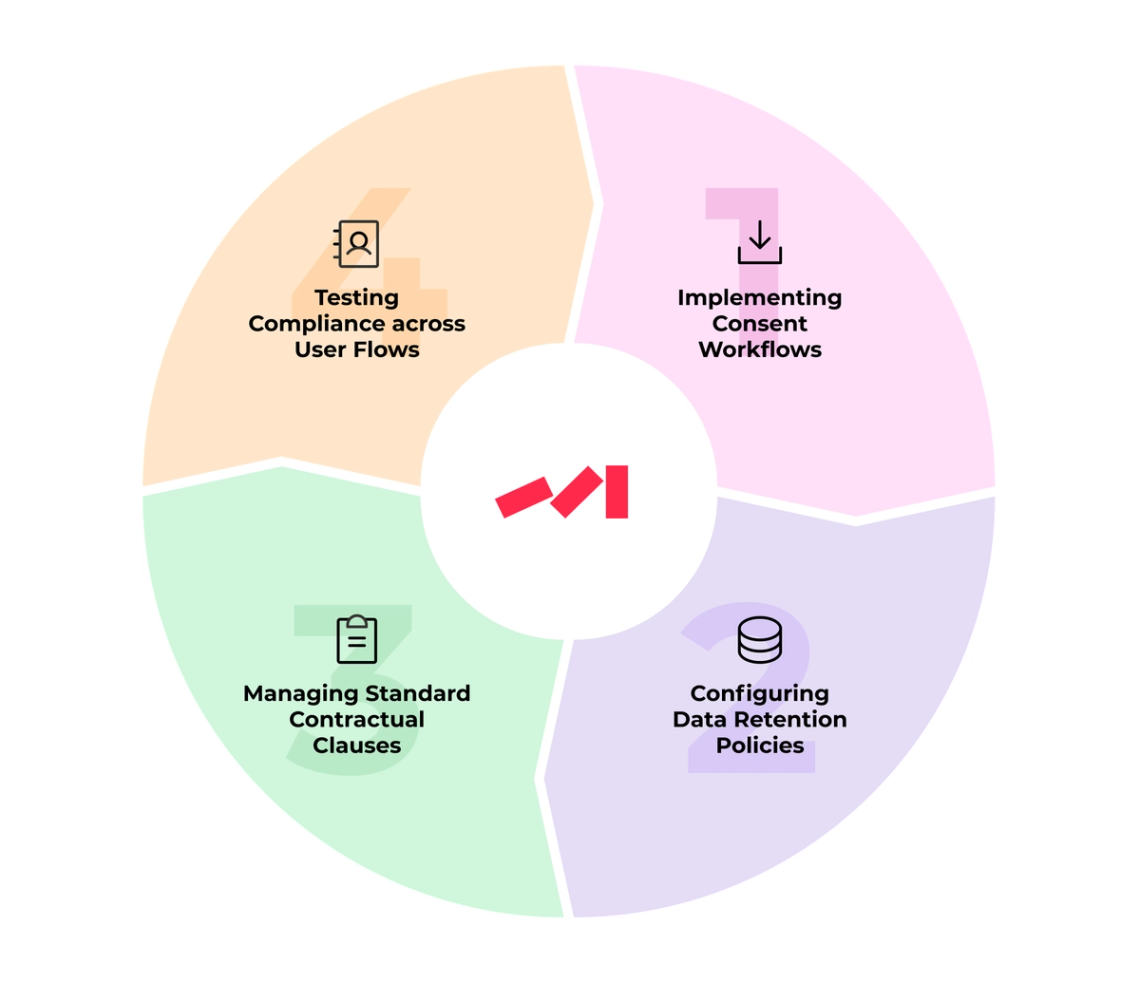
Developers did not sign up to become privacy experts, but GA4 GDPR compliance demands exactly that. Implementation requires configuring consent workflows, managing retention settings, and testing compliance across every user flow. This adds ongoing maintenance work that does not stop after implementation.
Data Protection Impact Assessments cost €3,000 to €15,000 per assessment for high-risk processing activities. These evaluations are required before deploying new systems, and they are not a one-time expense.
Security infrastructure upgrades typically require €20,000 to €80,000 in initial investment for mid-market organizations. Encryption upgrades, access control systems, and monitoring tools are non-negotiable under GDPR Article 32.
"Instead of actually adapting services to be GDPR compliant, US companies have tried to simply add some text to their privacy policies and ignore the Court of Justice." — Max Schrems, Honorary Chair, noyb.eu
Third-Party Dependency Costs
Consent Management Platforms represent one of the largest recurring expenses. Annual subscriptions range from €600 to €25,000, depending on data volume. Without a CMP, Google Analytics collects tracking information on arrival, which is exactly what regulators target.
Internal DPO salaries in the EU range from €50,000 to €120,000 annually. Outsourced DPO retainers cost €3,000 to €30,000 per year for SMEs. GDPR consultants charge upwards of $100 per hour, with data processing consultants costing $50,000 to $100,000+ annually.
Vendor risk assessments run $1,000 to $5,000 per vendor on average. Article 28 requires auditing each processor, so these costs compound quickly.
Compliance Audit Preparation Expenses
Periodic audits cost $5,000 to $10,000+, depending on risk profile and operational scale. Organizations that implement compliance automation report cutting ongoing costs by 40-60% and reducing audit preparation time by up to 50%.
More than half of companies still use manual DSAR processes, with over 26 employees involved at many organizations. The fully-loaded cost of manual GDPR administration for mid-market businesses often exceeds the cost of automation software that would replace it.
Per-person training costs range from €25 for online modules to €229+ for structured programs. Regulators expect annual training cadence, not optional refresh cycles.
An organization spending €40,000 on initial compliance will spend €100,000 to €180,000 on maintenance over the following three years without automation.
If your GA4 setup has compliance gaps, Darwin can find them before your next deal does.
What Does GA4 GDPR Setup Actually Require?
GA4 compliance requires a series of technical configurations that go beyond a one-time setup. Each step affects every page, every user flow, and every data transfer your site makes. The work does not stop after implementation.
Implementing Consent Workflows
Google Analytics cookies require explicit opt-in consent before activation. Showing a cookie banner is not sufficient. A Consent Management Platform must block service activation until users grant permission. Without this layer, Analytics collects tracking information on arrival, which is exactly what regulators target.
Google Consent Mode adjusts tag behavior based on consent choices. Tags load before the banner appears, but Consent Mode modifies their behavior after users respond. Advanced consent mode provides granular control over tracking information shared with third-party services. For EEA traffic, Analytics requires the ad_user_data and ad_personalization parameters. Missing these signals triggers notifications in your property settings within 48-72 hours.
Your privacy policy requires explicit disclosure of Google Analytics cookies: tracking information collected, provider, duration, and purpose. Articles 12, 13, and 14 of GDPR require informed consent, and these disclosures are not optional.
Configuring Data Retention Policies
GA4 defaults to two months for user-level and event-level retention. User-specific behavioral records for inactive visitors delete automatically unless you adjust settings. Standard properties allow extension to 14 months. When you modify retention periods, Analytics waits 24 hours before implementing changes.
Managing Standard Contractual Clauses
Using GA4 requires a signed Data Processing Agreement with Google. Without it, any data transfer to Google's US infrastructure violates GDPR. Standard Contractual Clauses cover the legal basis for that transfer. The European Commission updated them in June 2021 and older versions are no longer valid.
Testing Compliance across User Flows
GA4 compliance is not a one-time setup. Server-side tagging gives you control over what tracking information reaches Google before it leaves your infrastructure. Regularly audit GA4 reports for accidental PII leaks using the data deletion requests feature. Google masks detected PII automatically, but verification is your responsibility.
Why Do Compliance Failures Hit B2B SaaS Harder?
Compliance failures do not just cost B2B SaaS companies money. They kill deals before they start.
Enterprise Contract Requirements
GDPR applies to B2B relationships as strictly as B2C. When your platform processes customer behavioral records, you enter a legal relationship governed by Article 28, requiring formal Data Processing Agreements. Enterprise procurement teams know this. Operating without a compliant DPA creates immediate regulatory liability for both parties and flags your SaaS as legally risky, regardless of product quality.
Custom DPA negotiations extend sales cycles four to 12 weeks on average. Your prospect's legal team wants unlimited audit rights. You need reasonable scope limitations. They demand 24-hour breach notification. You require 72 hours to investigate properly.
Customer Data Processor Obligations
You remain fully liable for subprocessor failures. If AWS suffers a breach affecting your customer behavioral records, your customer can hold you accountable. The law does not separate your liability from your vendor's.
Every third-party service touching customer behavioral records creates subprocessor obligations requiring disclosure in your DPA: your error tracking tool, analytics platform, monitoring service, customer support system, payment processor. Each one requires documentation.
Regulatory Fine Calculations
Less severe infringements trigger fines up to €10 million or 2% of global annual revenue, whichever is higher. More serious violations reach €20 million or 4% of global gross annual revenue. European data protection authorities issued €1.2 billion in GDPR fines in 2025, with the cumulative total now exceeding €7.1 billion. The largest single fine in 2025: TikTok received €530 million for unlawful EU-US data transfers. Amazon holds the all-time record at €746 million.
Reputational Damage in B2B Sales Cycles
Reputational damage extends far beyond the penalty amount. Customers and partners lose trust in organizations that mishandle personal behavioral records. A single compliance incident leads to negative coverage, procurement disqualification, and long-term impact on customer loyalty.
VC Due Diligence Red Flags
Companies exposed to GDPR experienced an average 8% drop in profits, according to a 2025 Bocconi University study. A NBER study found a 26.1% reduction in monthly VC deals in EU tech ventures following GDPR enforcement. Lack of compliance documentation directly lowers company valuation when buyers perceive unquantified privacy risk.
"Complying with data privacy laws is a crucial part of protecting your business and your customers. Not only are there legal repercussions to violating these laws, but a lack of compliance may also lead to a loss of trust from your valued customers." — Jodi Daniels, Founder & CEO, Red Clover Advisors
A compliance gap analysis shows exactly where your GA4 setup creates risk. Darwin runs it end to end.
How Does GDPR Compliance Affect Analytics Accuracy?
When users decline tracking, analytics do not lose a few data points. Entire conversion paths disappear. With compliant cookie banners featuring equally visible reject buttons, rejection rates in Germany reach 50-60%. Attribution gaps follow immediately.
Missing Conversion Data from Opt-Outs
Consent Mode V2 measures events with reduced granularity when users decline. When a significant portion of users opt out, you face systematic underreporting of conversions that directly affects how you assess marketing effectiveness. When consent is not given, GA4 replaces missing user behavior with modeled estimates. The result is estimates, not actual behavior.
B2B Attribution Becomes Unreliable
Consent restrictions reduce attribution data volume by 30-40%. For B2B companies with long sales cycles and multiple touchpoints, the problem compounds. When users consent to tracking on some platforms but not others, journey visibility becomes partial. Attribution models must account for systematic gaps that correlate with user demographics and privacy consciousness, not random noise. Modeling partially compensates, but the gap widens with every quarter of incomplete behavioral records.
Product Decisions Made with Incomplete Data
Strict consent settings block essential user behavioral records from reaching GA4, leading to inaccurate tracking and incomplete reports. Product teams make prioritization decisions based on partial visibility. The users who opt in are not a representative sample, and they tend to skew toward more engaged, less privacy-conscious segments.
Competitive Disadvantage vs Non-Compliant Competitors
Competitors ignoring GDPR compliance for SaaS operate with complete behavioral datasets while compliant companies work with modeled estimates. They optimize faster, attribute more accurately, and make decisions with fuller context. This creates a systematic information gap that widens every quarter.
What Changes with Privacy-First Analytics?
Privacy-first analytics tools remove the need for consent-driven tracking. No consent banner required. No gaps from opt-outs. No engineering overhead to maintain consent workflows. The compliance cost drops to near zero on day one.
1. Privacy-First Analytics Platforms
Cookieless analytics tools like Fathom, Plausible, and Simple Analytics capture 100% of traffic without consent banners. Fathom starts at $15/month for 100,000 data points and collects no cookies. Plausible weighs less than 1KB, 45x lighter than GA4, and offers self-hosting from $9/month. Simple Analytics provides ad-blocker bypass with custom domains, starting free for up to five sites. All three are GDPR, CCPA, and PECR compliant by default.
2. Self-Hosted Options for Data Sovereignty
Matomo delivers complete ownership of user behavioral records with no sampling, regardless of traffic volume. The self-hosted version is free and open-source. Cloud hosting starts at $29/month for 50,000 page views. Self-hosting eliminates third-party data transfers entirely, solving HIPAA and geographic data residency requirements. You control retention, deletion, and access at the infrastructure level.
3. Calculating Total Cost of Ownership
Self-hosting costs become your server expenses, providing cost predictability at scale. For high-traffic sites, fixed infrastructure costs typically produce lower TCO than GA4's compliance overhead. When comparing analytics options, factor in not just subscription fees but engineering time, legal consultation, CMP costs, and the business value of complete versus modeled user behavior.
How Darwin Helps B2B SaaS Teams Manage Analytics Compliance
GA4 compliance is an ongoing operational cost. SaaS teams running analytics without a compliance audit carry unquantified legal risk into every enterprise deal and every board review.
Darwin works with B2B SaaS marketing and engineering teams to audit analytics configurations, identify consent gaps that create attribution blind spots, and align tracking with GDPR obligations. For a Cleo integration project, Darwin eliminated two manual reporting days per week and improved reporting accuracy from 70% to 90%.
- Data & Analytics Setup. Audit and realign your analytics stack so attribution reflects actual user behavior.
- Security & Compliance. Map your data flows to GDPR obligations and prepare documentation for enterprise procurement reviews.
- Integrations & Automations. Connect compliant tracking to your CRM and reporting with clear routing logic.
The outcome is an analytics stack that gives you accurate data and passes enterprise procurement reviews.
Compliance gaps in analytics create risk in enterprise deals. Darwin audits your stack and helps resolve them.
FAQs
1. What is the cost of GA4 compliance for B2B SaaS?
GA4 compliance costs range from €5,000 for small organizations to over €3 million for enterprises across multiple jurisdictions. The main expenses are consent management platforms, legal documentation, and engineering time.
2. Is Google Analytics 4 GDPR compliant in 2026?
GA4 can be configured for GDPR compliance, but it does not guarantee it by default. Data transfers to Google's US infrastructure and consent handling still create legal risk for EU-based companies.
3. Why is GA4 risky for EU-based SaaS companies?
GA4 sends user behavioral records to Google servers in the US, which requires Standard Contractual Clauses and a signed Data Processing Agreement. Without proper consent workflows, any data collection on arrival constitutes a GDPR violation.
4. Does GA4 affect data accuracy under GDPR consent requirements?
When users decline consent, attribution data volume drops by 30-40%, reaching 50-60% in EU markets with compliant banners. GA4 replaces missing records with modeled estimates, not actual user data.
5. What are privacy-first alternatives to GA4?
Plausible, Fathom, and self-hosted Matomo capture 100% of traffic without consent banners and are GDPR compliant by default. They eliminate the compliance layer entirely rather than working around it.
 Sergey Kisly